
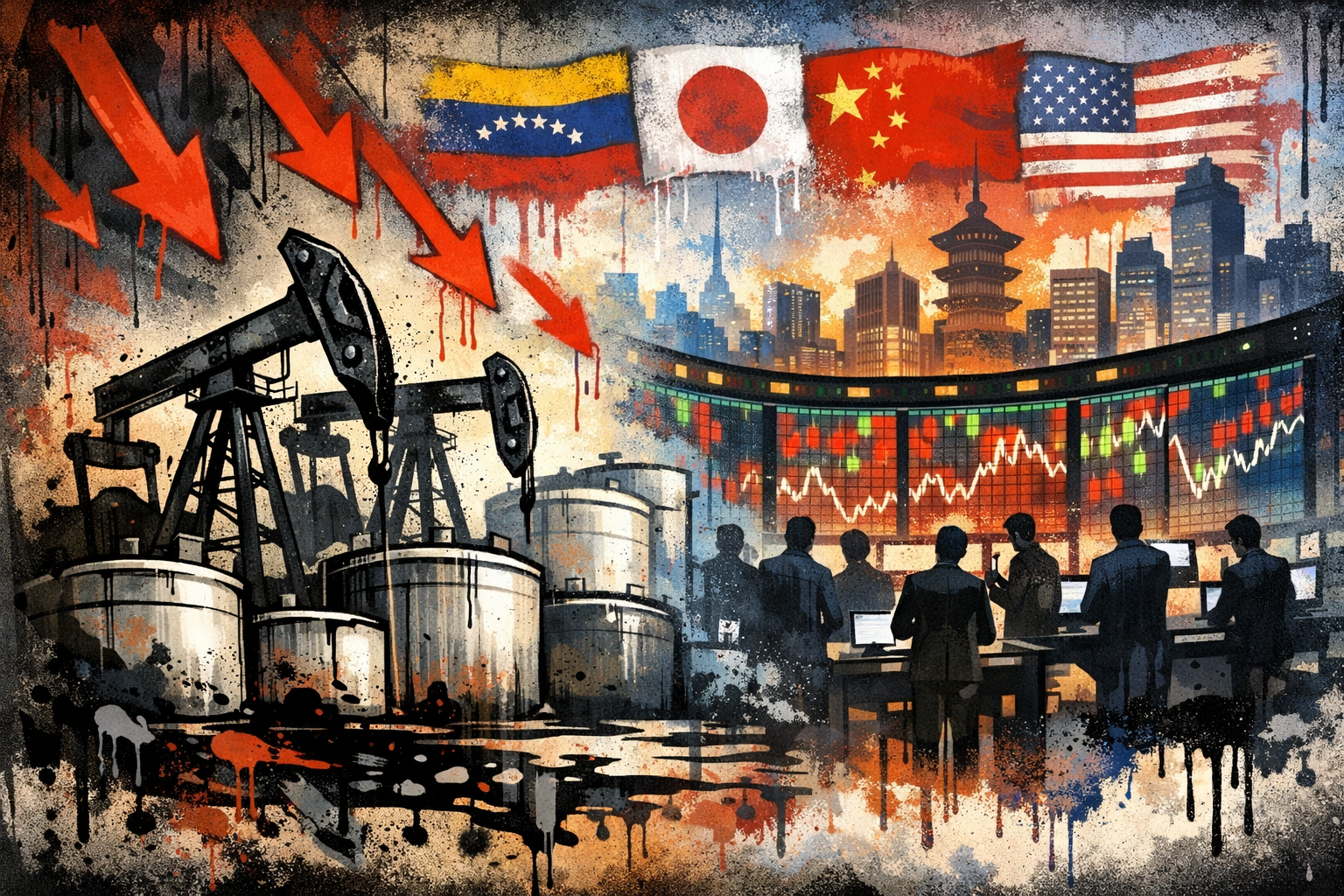
Global markets moved cautiously in Asian trading as investors digested political upheaval in Venezuela, fresh trade tensions between Japan and China, and renewed rhetoric from Washington over Greenland.
Oil prices extended losses, resource stocks diverged, and currencies held steady as traders looked ahead to key US economic data later this week.
Asian markets slip as crude takes a hit
Crude futures slid while resource-related equities advanced in parts of Asia, reflecting mixed sentiment over global growth and energy supply.
US crude fell 1.5% to $56.23 a barrel, while Brent declined 1.17% to $59.99, extending losses after comments from US President Donald Trump on Venezuela’s oil reserves.
Japan’s Nikkei index fell 1.28%, weighing on regional benchmarks, while MSCI’s Asia-Pacific shares outside Japan slipped 0.4%.
In contrast, Australia’s S&P/ASX 200 index rose 0.1%, supported by commodity producers after an overnight surge in industrial metals prices.
Copper had hit a record high in the prior session, while nickel jumped more than 10% on supply concerns, though copper eased slightly in Asian trading.
The dollar held most of its recent gains, with the dollar index almost unchanged at 98.56.
The euro traded at $1.17, while the yen weakened marginally to 156.48 per dollar.
Gold prices slipped 0.5% to $4,468 an ounce, while bitcoin fell 1.07% to around $92,711.
Venezuela to supply oil to the United States
Oil markets were pressured by Trump’s announcement that Venezuela would “turn over” between 30 million and 50 million barrels of crude to the United States, to be sold at market prices.
Trump said the proceeds would be controlled by the US government and used to benefit both countries following the capture of Venezuelan leader Nicolás Maduro over the weekend.
The volumes cited would represent roughly 30 to 50 days of Venezuelan oil production before the US imposed a partial blockade last month, though analysts noted the move is more politically significant than economically transformative.
West Texas Intermediate fell as much as 2.4% after Trump’s comments before stabilizing near $56.40 a barrel.
Venezuela holds the world’s largest proven crude reserves, but years of underinvestment and sanctions have reduced output to less than 1% of global supply.
Analysts say it would take years and billions of dollars to meaningfully revive production.
Trump did not specify the exact origin of the oil, though Venezuela has accumulated a backlog of unsent crude in storage tanks and aboard ships since the blockade began.
Chevron remains the only US company exporting Venezuelan oil under a sanctions exemption, having booked at least 11 vessels to load crude from government-controlled ports.
Japan criticizes China’s export controls
Beijing announced a ban on exports of dual-use items to Japan that can have both military and commercial applications, effective immediately.
Tokyo lodged a formal protest, calling the move unacceptable and a deviation from international practice.
Japan’s Chief Cabinet Secretary Minoru Kihara said the government would closely examine the impact and consider appropriate responses.
Estimates suggest that dual-use items account for more than 40% of Japan’s imports from China, its largest trading partner.
Concerns that the restrictions could extend to rare earths weighed on automaker shares while boosting stocks linked to rare-earth alternatives.
Economists warned that prolonged restrictions could significantly dent Japan’s economy, given its heavy reliance on China for critical materials.
US plans for Greenland draw scrutiny
Adding to geopolitical uncertainty, the Trump administration signaled it is considering “a range of options” to acquire Greenland, including the possible use of the US military, White House press secretary Karoline Leavitt told CNBC.
The comments drew pushback from Denmark and other European NATO members, who reiterated that Greenland’s future is for Denmark and Greenland alone to decide.
Trump has argued that Greenland is vital for US national security, citing Russian and Chinese activity in the Arctic.
While Secretary of State Marco Rubio reportedly told lawmakers the administration’s preference is to buy the territory, the rhetoric has raised concerns among US allies.
The post Morning brief: Asian markets slide, US plans aggressive Greenland actions appeared first on Invezz