
The post Privacy Infrastructure Is Becoming Inevitable and This Project Is Building It appeared first on Coinpedia Fintech News
Conversations around blockchain have historically revolved around self-sovereignty, scalability (TPS), programmability, and adoption metrics. However, as blockchains mature, one foundational principle is becoming non-negotiable if the cypherpunk ethos of sovereignty, autonomy, and decentralization needs to be preserved: privacy.
Financial transparency may have been an early design choice when the privacy tech stack was still too primitive. As Satoshi noted, “Privacy can still be maintained by breaking the flow of information in another place: by keeping public keys anonymous.”
Today, institutions, enterprises, and everyday users alike are recognizing a stark reality. Without privacy rails, blockchain adoption will once again replicate the surveillance-driven models that defined Web2.
This realization is giving rise to an entirely new category of blockchain infrastructure. Not just privacy coins, but vertically integrated privacy ecosystems designed to embed privacy across every layer of online and on-chain interaction.
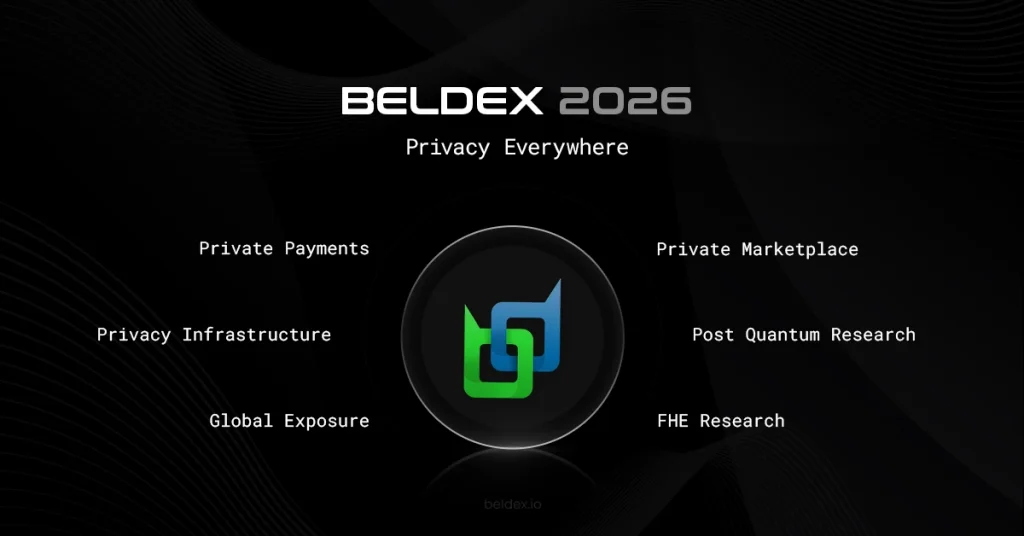
Entering 2026, Beldex, a network building privacy-first infrastructure, is attempting to define this transition through key protocol upgrades, research initiatives, ecosystem expansion, and UX enhancements.
From messaging, browsing, and data routing, to identity, and cross-chain interoperability, Beldex is building for privacy in every online interaction.
Grayscale’s Q4 2025 Crypto Sectors Quarterly Report identified Beldex as a leading performer within the privacy infrastructure narrative, highlighting tools such as BChat, BelNet, Beldex Browser, and BNS as components of a vertically aligned privacy stack.
Institutional attention toward this narrative shift is becoming increasingly visible. Firms such as a16z have emphasized the strategic importance of privacy, noting that “privacy will be the most important moat in crypto.”
In 2026, Beldex’s roadmap marks a robust technical advancement directed towards privacy-centric real-world use cases.
FHE and Post-Quantum Cryptography in BChat
Advancements in FHE and post-quantum cryptography have raised the bar for privacy. Fully Homomorphic Encryption allows for computations on encrypted data. The output of the computation is revealed only to the intended party without leakage or exposure to intermediaries.
For a messaging system like the BChat private messenger, this opens up entirely new possibilities for spam detection, abuse filtering, and even AI-driven content moderation. The goal isn’t just encrypted conversation, but encrypted computation on messaging to foster a safe online environment.
Privacy must also survive the test of time. Since much of today’s cryptography relies on elliptic-curve assumptions that would later be vulnerable to Shor’s algorithm in a mature quantum-computing environment, data must be resilient to the ‘harvest now, decrypt later’ threat model. Beldex’s post-quantum cryptography research aims to mitigate this threat by replacing vulnerable primitives with quantum-resistant constructions.
Beldex explores research into FHE and post-quantum systems for future integration into BChat with the objective of protecting conversations of the past, present, and future.
Enhancing the Network Layer Privacy
Dandelion++ is an upcoming network level upgrade on the Beldex network. It plays a critical role in enhancing the privacy below the surface. This network layer upgrade significantly reduces the ability to trace transactions back to their origin by hiding the IP of the block producer. Dandelion++ obscures where transactions originate from by changing how transactions travel, which makes it significantly harder to correlate transaction timing, place, node, and the network position.
Real World Adoption: A POS Dashboard for Businesses
Private transactions are siloed without real-world usage. Privacy introduces fungibility, a quality that’s considered cornerstone to real-world adoption of crypto transactions.
To ensure businesses across the globe can accept BDX in-store, Beldex plans to introduce an easy to use, quick-setup Point-of-Sale dashboard. This dashboard will enable businesses to accept the BDX native coin. Enabling infra for private payments ensures that sensitive details, such as sender/receiver identities, exact amounts, transaction histories, and wallet balances, remain completely shielded.
While customers avoid transaction profiling, merchants can reduce the surface area for data harvesting. The Obscura hardfork made accepting payments feasible and practical by integrating Bulletproofs++, which reduces proof overheads by approximately 38%, resulting in faster and more efficient transactions with smaller proofs.
Through the upcoming Point-of-Sale dashboard and integrations like BTCPayServer plugins, accepting BDX becomes easier for businesses, enabling them to participate in a more private, decentralized economy.
MNApps: Privacy-First Web Services
As the usage expands, ecosystem growth depends on accessible applications and clear discovery paths. MNApps are privacy-first web services, web applications hosted on the BelNet overlay network with .bdx domains. This helps conceal the host identity, ensures that hosted web apps remain free of censorship, and allows users to connect to the apps and services privately.
MNApps leverage BelNet, an onion-router based decentralized VPN that masks the hosts IP address. The upcoming MNApp Store will provide a unified environment for publishing, discovering, and accessing web applications hosted on BelNet and supported by Beldex’s masternode infrastructure.
Identity, Naming, and Private Marketplaces
The Beldex Name Service (BNS) introduces human-readable identifiers that work consistently across wallets, messaging, browsing, and other applications.
The BNS Marketplace is a secondary marketplace that extends this system into a peer-to-peer market, where users can buy and sell BNS names through an auction-based model, transforming BNS names into auctionable digital property.
Verifiable Random Functions-based Consensus
Verifiable Random Functions (VRFs) fundamentally improve how randomness is generated and verified, ensuring outcomes that are both unpredictable and provably fair. In Beldex, VRF aims to introduce a consensus level randomness upgrade to enhance the core consensus mechanism.
With the VRF framework, Beldex’s validator selection procedure becomes dynamic and highly probabilistic. Instead of quorums, VRF will allow two-thirds of all eligible masternodes to take part in the consensus.
Beldex plans to publish the VRF-based consensus research paper for peer review in Q1 2026, which will explain the design, security assumptions, and implementation approach behind the upgrade.
FHE and post-quantum cryptography research shows Beldex’s long-term commitment to building privacy infrastructure to survive technological transitions. Through usability enhancements like the POS dashboard for businesses, and privacy-first web services, Beldex addresses real privacy concerns in today’s surveillance-driven world.
These privacy rails are laid to ease future innovation and build resilience. With the infrastructure in place, privacy can scale naturally across messaging, payments, applications, and digital identity.